Sunday, May 5, 2013

TWO WHEELER MAINTENANCE TIPS


For a trouble-free ride on your favorite two-wheeler, it is imperative that you maintain it properly and inspected it regularly for minor wear and tear. Proper maintenance is important for optimum and trouble-free performance from your vehicle.

 Preventive Maintenance

1. Make sure that you check your tyre treads once a week. Have the wheels balanced and the alignment checked if the wear is uneven.

2. Check your tyres for cuts and scrapes on your tires, which could cause a blowout. Add air pressure as required. Many blowouts are the result of low air pressure.

3. Examine both of your wheels for missing or loose spokes. Check the rims for cracks or dents.

4. Lift the wheel off the ground and spin it. Then watch its motion, listen for noise and move it from side to side to check for looseness.

5. For smooth operations, inspect the controls. Watch for kinks or broken strands in your cables. Also, lubricate the control mechanisms at each end of the cables.

6. Oil the chain and check the sprockets for worn teeth.

7. Does the motorcycle bounce several times after you ride over a bump? Do you hear a big clunk? If the answer to either of this is yes, adjust or replace the shock absorbers.

8. Be on the lookout for loose or missing nuts, bolts or cotter pins. If you keep your bike clean, it’s easier to spot the missing parts.

9. Adjust your brakes so they lock the wheel when fully applied (see your owner’s manual for instructions). If the wheel does not lock, or if you hear a scraping sound when you’re trying to stop have the lining checked.

10. If you suspect that your motorbike can land you into trouble, fix things right away. That is the only way you can avoid an acccident.


Cleaning the Two Wheeler


A clean bike is important for long-term fitness and for value of the vehicle. Maintenance of a clean bike is easier, and it also less expensive to operate.

A few tips that will help keep your vehicle clean:
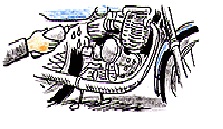
  • Before you clean the vehicle, ensure that the ignition switch unit, H.T. Coil and silencer are covered using plastic sheets.
  • Clean the vehicle using low-pressure water.
  • All painted surfaces should be washed only with water, as kerosene or detergent will damage the paint
  • Take care not to apply water on the electrical parts
  • For cleaning the engine externally, brush it with kerosene and wipe it dry with a clean rag.
  • Dry the vehicle and lubricate it after you wash it
At times, water may enter on the brake liners during washing, leading to brake slippage. Therefore, make it a point to dry the liners by braking frequently till the brake starts working effectively.

After you’ve cleaned the vehicle :
  • Replace or top up engine/ Gear box oil
  • Clean the air filter
  • Clean the spark plug, and seal the electrode gap
  • Overhaul the carburetor
  • Adjust the control cable
  • Tighten nuts, bolts and fasteners
  • Clean and adjust front and rear brakes
  • Check and adjust steering column play
  • Check for proper functioning of lights, switches and horn
  • Check battery electrolyte level and top up with distilled water
  • Check and adjust drive chain tension
  • Check and adjust spoke tightness / rim runout
  • Check and clean inline fuel filter 

Lubricating your Two Wheeler


For a smooth and easy ride, it is important to lubricate your vehicle from time to time. What are the parts that need to be lubricated?
  • Rider seat pivot
  • Control cables
  • Brake lever, pedal and clutch lever
  • Front suspension
  • Speedo gear / pinion / cable
  • Steering races
  • Stand pivot
  • Front wheel bearing
  • Gear shifter assembly
  • Brake actuating shaft


Tyres, wheels and windshields


To keep the performance of your motorbike at the maximum and improve its looks, due care of tyres, wheels and windshield is essential. A constant degradation of these parts takes place that may either cause a poor performance level of the vehicle or may even lead you into uninvited trouble.

This degradation caused due to friction or unfavorable driving conditions like uneven roads, road grease, insects, brake dust etc., can be slowed down by taking few simple steps. The following steps may enable your machine to deliver peak performance:

To keep the tyres intact and in perfect condition is very essential for safe driving and high mileage. The manufacturer's instructions should always be followed. The right air pressure assists the machine in giving high output and also protects the tyre from corrosion.

It also gives a smoother ride and excellent (skid free) braking. Do not use any cheap tyre cleaner, but always use a good quality cleaner. Moreover harsh braking is to be avoided for long life of the tyres as this causes depletion of the tyre rubber due to friction.

Windshield looks good and is useful only when it does not have any scratches. Therefore it should be dampened for some time before washing for easier bug removal. Scratch-removing products should also be used to erase the scratches.

Wheels are very important for smooth driving and perfect looks and are easily damaged by the use of harsh chemicals, brake dust and road salts. To avoid such ugly looks wash and wax your wheels weekly and use a corrosion protectant.

During washing, however, take care to avoid excessive wetting of brake shoes and discs as this may affect the braking while driving. Do not wash brake discs with cleaners whose compounds include chlorine or silicon. Chlorine causes rust and silicon makes brake discs slick, diminishing their usefulness and safety.

After the initial 500 miles...

·         Change engine oil.
·         Replace oil filter.
·         Inspect air cleaner and service as required.
·         Inspect brake pad linings and discs for wear.
·         Inspect oil lines and brake system for leaks.
·         Lubricate the front brake hand lever, the throttle control cables and the clutch control cable.
·         Check engine idle speed.
·         Check operation of electrical equipment and switches.
·         Check tightness of all fasteners, except engine head bolts.
·         Check tyre pressure and inspect tread.
·         Check rear drive belt.
·         Change transmission lubricant and clean magnetic drain plug.
·         Inspect fuel valve lines and fittings for leaks.
·         Check rear shock absorbers.
·         Check brake fluid reservoir levels and condition.
·         Check stabilizer links and engine mounts.
·         Check primary chaincase, lubricate and clean magnetic drain plug.
·         Check wheel spoke tightness.
·         Check cruise control/disengage switch.
·         Check rear fork pivot nut.
·         Check air suspension for correct operation and leakage.
·         Check idle speed.
·         Road test.
·         See your dealer.

First aid for your Two Wheeler


      If even after following the above maintenance tips your vehicle continues to give you problems, you should take it to an authorized dealer. However, follow these simple steps before approaching the dealer.

In case of starting trouble
  • Check fuel in fuel tank / fuel cock position / fuel tank cap vent hole
  • Check fuel pipe for pinched / twisted
  • Check and clean air filter element
  • Check and clean spark plug and adjust electrode gap
  • Check ignition switch / engine kill switch position
  • Check fuel in fuel tank / fuel cock position / fuel tank cap vent hole
  • Check fuel pipe for pinched / twisted
  • Check and clean air filter element
  • Check and clean spark plug and adjust electrode gap
In case of high fuel consumption
  • Check for fuel leakage from fuel pipe, petrol tank cap, and petrol cock
  • Check tyre pressure
  • Check and clean air filter element
  • Check and clean spark plug and adjust electrode gap
  • Check whether brakes are dragging

Tuesday, January 17, 2012

VACUUM CLUTCH


The vacuum clutch is operated by the vacuum existing in the engine manifold. Fig shows the mechanism of a vacuum clutch. It consists of a vacuum cylinder with piston, solenoid operated valve, reservoir and a non-return valve. The reservoir is connected to the engine manifold through a non return valve. Vacuum cylinder is connected to the reservoir through solenoid operated valve. The solenoid is operated from the battery and the circuit incorporates a switch which is placed in the gear lever. The switch is operated when the driver holds the lever to change gears.

When the throttle is wide opened, the pressure in the inlet manifold decreases due to which the non-return valve closes, isolating the reservoir from the manifold. Thus a vacuum exists in the reservoir all the time.In the normal operation, the switch in the gear lever remains off, the solenoid operated valve remains in its bottom position. In this positions the atmospheric pressure acts on both the side of the vacuum cylinder, because the vacuum cylinder is open, so also atmosphere though a vent. When the driver holds the lever to change the gear, the switch is closed; energizing the solenoid which pulls the valve up. This connects one side of vacuum cylinder to the reservoir. Due to the difference of pressure on the vacuum cylinder piston, it moves. This movement of the piston is transmitted by a linkage to the clutch, causing it to disengage. When the driver is not operating the gear lever, the switch is open and the clutch remains engaged due to the force of springs.

Friday, January 6, 2012


ELECTROMAGNETIC CLUTCH

In this system the clutch is controlled by means electric current supplied to the field windings in the flywheel. The fly wheel is attached with the field winding, which is given electric current by means of battery, dynamo or alternator. The construction feature of main components is almost similar to the single plate clutch. When electric current is supplied to the windings the flywheel will attract the pressure plate and clutch plate is forced between pressure plate and flywheel resulting in engagement. When the supply to the winding is cut off the clutch is disengaged by releasing the pressure plate due to the force exerted by the helical springs or tension springs. Electromagnetic clutch consists of a clutch release switch. When then driver holds the gear lever to change the gear, the switch is operated cutting off the current to the winding which causes the clutch disengaged.When the vehicle is stalling, the engine speed is lower & the dynamo output is low, the clutch is not firmly engaged. Therefore, three springs are also provided on the pressure plate which helps the clutch engaged firmly at low speed also.


The forces of the electromagnet can be regulated by means of an electrical resistance provided with acceleration system and controlled by the accelerator pedal. When the speed is increased, the accelerator pedal is pressed and the resistance is gradually cut off and thus in this way, force of electromagnet is increased and clutch transmission becomes more rigid

Thursday, January 5, 2012


CONE CLUTCH

Cone clutch are wedge clutch provides a positive drive when the external face of the male cone member engages with the internet face of recessed conical member. The facing is usually fitted to the female or recessed member in order to improve heat dissipation and durability. Normally cone clutch are used with epicyclic gear trains for a higher torque transmission. The energy which a cone clutch can absorb during on engagement is less compared to the energy absorbed by a multiple clutch. But it is compact, cheaper and requires low clamping load due to the wedging action. The cone clutches are loaded by spring or hydraulic cylinders. Wedge angle and accurate axial alignment are the two important factors for good cone clutch performance. If the wedge angle is very less, it results in excessive wedge action and fierce engagement. This in turn results in difficult operation for disengagement. If the wedge angle is too large it reduces torque transmission capacity of the clutch and make the clutches to skid. Semi-cone angle of 12-16 are commonly used for effective torque transmission.
The torque transmitted by a cone clutch is given by  
T = μW (r1 + r2) / 2 sin α
Where, r1 and r2 are the radius of large and small cone (friction) in meters. α is the semi – cone angle.
During the engagement of clutch the driven member is forced towards the driving cone by the spring force. Hence the power is transmitted from the engine to the driving cone, driving cone to driven cone and driven to the gear box. When the clutch is to be disengaged the driven cone is to be pulled off by means of actuates cenkages and contact surfaces are separated hence no power is transmitted to the clutch shaft.

Tuesday, January 3, 2012


      OVERDRIVE

Overdrive is a device to step up the gear ratio in the car. It is fitted in between transmission and the propeller shaft. It enables a high cruising speed to be attained with a comparatively low engine speed (upto 20 – 25%) on long journeys. This results in less wear of the engine and decreases vibration and noise. As the friction lows at lower speeds is less, there is a saving of fuel also with the overdrive. Overdrive is generally fitted on top gear only. But in some sport cars, over drives are also fitted on gears other than the top gear which increases the torque ratios available. For examples, when overdrive is fated on top, third and second gear, seven forward speeds or torque ratios are available. The overdrive may be operated either manually or automatically at a predetermined speed.
To understand the working of an overdrive, consider the above figure. It consists of an epicyclic gear train in which the sun gear is free to rotate on the input shaft, while the carrier can move on splines, on the input shaft. A freewheel clutch is also fitted on the input shaft splines. The output shaft is connected to the ring. When the sun gear is locked with the casing i.e., it becomes stationary, of the output shaft is increased i.e., overdrive is engaged.
When the sun gear is locked to the carrier or to the ring, solid drive through n is obtained. Thus depending on the locking of the sun gear with ring gear or with carrier the overdrive or the normal direct drive is obtained. There is another possible control of the mechanism i.e., when the sun wheel is kept free to rotate on the input shaft. In this case there is direct drive through the freewheel clutch when the engine develops power. However when the accelerator is brought to zero position and the engine is simply idling, the output shaft tends to override the input shaft. The roller of the freewbeel clutch in this case no longer remains wedged and the car free wheels. Thus for gear changing one simply has to lift his foot off the accelerator pedal, the clutch need not be operated.

Monday, January 2, 2012


TORQUE CONVERTER

The torque converter is modified form of fluid flywheel. Fluid flywheel is used for the transmission of power, whereas torque converters are used to transmit the power with varied torque as per the requirement. In addition the driving member (impeller / pump) and driven member (turbine), it consists of a reaction member also (stator). In its simplest form it consists of an impeller connected to the crankshaft, turbine connected to output shaft and stator mounted on overrunning clutch on stationary component impeller is normally an integral part of the converter housing. (It is generally welded to the cover half during the manufacturing). 

Turbine and stator are enclosed within the welded housing. The stator incorporates a one-way clutch and mounts on a stationary support shaft that is grounded to the transmission case directly or indirectly through the transmission pump assembly. The impeller and turbine blades are designed with special features. The curved shape of the impeller blades in a backward direction gives added acceleration and energy to the oil as it leaves the impeller. The curved shape of the turbine vanes is designed to absorb as much energy as possible from the moving oil as it passes through the turbine. The vane curvature has two functions that give the turbine excellent torque absorbing capacity. It reduces shock losses due to the sudden change in oil direction between the impeller and turbine. It also takes advantage of the hydraulic principle that the more the direction of a moving fluid is diverted, the greater the fore that fluid exerts on the diverting surface. The fluid impact is absorbed along the full length of the vane surface as the fluid reverses itself. The stator is the third bladed member of the converter. During the torque phase, its function is to redirect the fluid flow as it leaves the turbine and reenters the impeller. This assists the impeller rotation and gives a thrust boost to the fluid discharge.

Converter starts operating when the impeller starts rotating, with the engine providing the required input. The impeller creates a centrifugal pumping head or vortex flow. At the same time, the fluid must follow the rotational inertia or the effort of the impeller. These two fluid forces combine to produce a resultant force in the form of an accelerated jet stream against the turbine vanes. The impeller and turbine attempts to act as an effective fluid coupling by featuring curved impeller and turbine vanes rather than a straight radial design. The turbine vanes reverse the fluid direction. The curved turbine vanes provide efficient energy transfer, but the reentry of the remaining fluid thrust back to the impeller, works against the impeller and crankshaft direction. Hence, it is necessary to introduce the stator element to make the converter work. The stator is employed between the turbine, outflow and impeller inflow to reverse the direction of the fluid and make it flow in the same direction as that of the impeller. Instead of the fluid opposing the impeller, the fluid energy now assists the impeller and crankshaft rotation. This results in boosting the rpm of’ the impeller. This allows the impeller to accelerate more and recycle the fluid with a greater thrust against the turbine vanes. The purpose of using the remaining fluid energy to drive the impeller is referred as regeneration gain. The stator is mounted on a one-way clutch. During the torque phase, the stator remains locked and at coupling speed it overruns.

The torque multiplication occurs when the turbine is turning at a slower speed than the impeller and the stator is stationary / reactionary. This is called torque phase, slip phase or stall phase. This sequence generates a boost in output torque. Recycling of the fluid permits more of the impeller input to be used in increasing the jet stream velocity and turning effort of the turbine. By helping the impeller to accelerate the fluid thrust against the turbine, the stator provides the basis for torque multiplication The curved turbine blades absorb the energy from the impeller discharge until the force of fluid is great enough to overcome the turbine resistance to motion. The converter torque is equal to the product of effective fluid force and working radius of the turbine (torque= force x lever arm radius). It is similar to the torque multiplication by gear reduction. The maximum throttle occurs with the engine at wide open throttle (WOT) and zero turbine speed. This is commonly referred as torque rating or stall torque of the converter. For best efficiency, engineering design of the three-element converter keeps the maximum torque ratings within a range of 2:1 to 2 5:1.
During the torque phase, vortex flow is the predominant force in the fluid. Therefore the fluid cycles like a continuous chain from the impeller to the turbine and back to the impeller through the locked stator. This action is continuous until the turbine speed is at nine-tenths of the impeller speed, at which the converter has achieved a speed ratio more than 90%. After a moment at stall the turbine and vehicle starts moving. Once the turbine starts, it becomes easier and easier for the fluid force to drive the turbine and vehicle. The turbine rpm actually starts to gain and approach impeller speed. As the turbine gains the speed, the turbine lever arm absorbs less and less of the fluid force and converter torque output gradually drops. 

The fluid thrust under vortex influence is trying to hit a moving target that is moving away from it faster and faster. Finally when the converter has reached a speed ratio of more than 90%, the converter enters the coupling phase of the operation. The stator is no longer needed and must freewheel with the rotary flow. The vortex effect on the fluid has dropped significantly and the rotary flow is now the main force. The rotating inertia of the fluid mass, impeller and the turbine form a hydraulic lock or bond. The converter is now in coupling phase and the torque ratio is 1:1. When the speed difference between the impeller and turbine is at its minimum, it is referred as coupling phase. It occurs when the torque converter is operating at its greatest hydraulic efficiency. At this point the stator freewheels and there is no torque multiplication.

Sunday, January 1, 2012

FLUID COUPLING

Fluid coupling is the simplest form of the hydrodynamic drive consisting of two similar members with straight radial vanes referred as impeller (pump) and turbine. It is used to transmit the power from the engine to the remaining parts of the transmission. Since the fluid coupling is always a major part of the engine flywheel assembly, it is also called fluid flywheel.

The working principle of a fluid coupling can be understood easily with the help of two fans facing each other. When one fan is turned on and the air stream causes the second fan to turn even though it is not switched on. The first fan is the driving member or the impeller and the second fan is the driven member or the runner. This is the simple fluid coupling with air serving the function of fluid.  The figureshows the simple construction of a fluid flywheel. It consists of a two half dough nut shaped shells equipped with interior fins that radiates from the hubs. One shell is mounted on the crankshaft and is called impeller or driving member. The other shell is mounted on the driven shaft and is called runner or driven member. The two shells are very close with their ends facing each other and enclosed in housing, so that they can be turned without touching each other. The housing is filled with liquid / fluid. When the engine drives the impeller it sets up the fluid mass into motion, creating a fluid force. The path of the fluid force strikes on a solid object, the turbine. 

The impact of the fluid jet stream against the turbine blades sets the turbine in motion. With this energy cycle has been completed: mechanical to fluid and back to mechanical. When the impeller spins up, two separate forces are generated in the fluid. One is rotary flow, which is the rotational effort or the inertia of the impeller rotation. The other is vortex flow which circulates the fluid members (it is at right angles to the rotary flow) and is caused by the centrifugal pumping action of the rotating impeller. The lag of the runner behind the impeller is known as slip, and depends upon the engine speed and load. The slip is maximum with the vehicle at rest (turbine stationary) and the throttle open to cause the impeller to start circulating oil. As explained earlier the oil is having both rotary and vertex flow at this time. The oil flies out against the curved interior due to the centrifugal force. The rotary flow starts the movement of the runner. As the turbine begins to rotate and catch up impeller speed, flow gradually decreases because of the counter pumping action of the turbine. This permits the rotary action to become greater influence on the fluid and the resultant thrust becomes more effective in propelling the turbine. Finally, at greater speed ratios over 90% the rotary inertia or momentum of the fluid and coupling members forms a hydraulic lock or bond, and the coupling members turns as a single unit. This is referred as coupling point. In an ideal liquid coupling, the runner would attain the same speed as the impeller, so as to receive all the power imparted by the engine. In commercial designs the runner speed becomes almost equal to that of the impeller only under the best operating conditions, when the efficiency of the coupling is highest.

Friday, December 30, 2011


SYNCHROMESH GEAR BOX

Synchromesh gear box is an automatic means for matching the speeds of engaging dogs. Synchromesh gear box is a device which facilitates the coupling of two shafts rotating at different speeds. Synchromesh unit is used in most of modern gear boxes. In synchromesh gear box, sliding dog clutches are replaced by synchromesh device. The synchromesh devices are used to simplify the operation of changing gear. Synchromesh device helps unskilled drivers to change gears without the occurrence of clashes and damages.

By synchromesh device, the members which ultimately are to be engaged positively are first brought into frictional contact and then when the friction has equalized their speeds, the positive connection is made.


The basic requirements of synchromesh device are:
(1) A braking device such as cone clutch.
(2)  To permit easy meshing means of releasing pressure on the clutch before engagement of gears.

The engine shaft carries a pinion which meshes with a wheel fixed to the layshaft, while the gear on the mainshaft is free to rotate and is permanently meshed with another wheel fixed to the layshaft. Both the pinion and the wheel on the mainshaft have integral dog tooth portions and conical portions. The synchronizing drum is free to slide on splines on the mainshaft. This drum has conical portions to correspond with the conical portions on the gearbox shaft pinion and on the wheel that rotates freely on the mainshaft. The synchronizing drum carries a sliding sleeve. In the neutral position, the sliding sleeve is held in place by the spring loaded balls which rest in the dents in the sliding sleeve (or ring gear). There are usually six of these balls.
In changing gear, the gear lever is brought to the neutral position in the ordinary way, but is immediately pressed in the direction it has to go to engage the required gear. When a shift starts, the spring loaded balls cause the synchronizing drum and sliding sleeve, as an assembly to move toward the selected gear. The first contact is between the synchronizing cones on the selected gear and the drum. This contact brings the two into synchronization. Both rotate at the same speed. When the speeds of the two have become equal, a slightly greater pressure on the gear lever overcomes the resistance of the balls. Further movement of the shift fork forces the sliding sleeve on toward the selected gear. The internal splines on the sliding sleeve i.e. the dog portion, match the external splines on the selected gear the dog teeth are locked up, or engaged, and thus positive connection is established. The gear shift is completed.

CONSTANT MESH GEAR BOX

In constant mesh gear box all the gears are always in mesh and the engagement between the gears which are freely rotating on the transmission main shaft and the transmission main shaft is effected by moving the dog clutches, as explained below.
The engine gear box shaft is integral with a pinion. The pinion meshes with a wheel on the layshaft. The layshaft is therefore driven by the engine shaft. Three more wheels are fixed to the layshaft as in the sliding mesh gearbox. These gears rotate with the layshaft. The transmission main shaft is just above the layshaft and in line with the engine shaft. The three gears (first gear, second gear and reverse gear) on the main shaft are perfectly free to turn on the main shaft. These three gears are in constant mesh with the three wheels on the layshaft. One of these three gears meshes with a wheel on the layshaft through an idler wheel which is mounted and freely rotating on a pin fixed to the gearbox casing. 


The three main shaft gears are, therefore constantly driven by the engine shaft, but at different speeds. The first gear and the second gear rotate in the same direction as the engine shaft while the reverse gear rotates in the opposite direction to the engine shaft.
If anyone of the gears on/the mainshaft is coupled up to the main shaft, then there will be a driving connection between the main shaft and the engine shaft. The coupling is affected by the dog clutch units. The dog clutch members are carried on splined (or squared) portions of the mainshaft. They are free to slide on those squared portions, but have to revolve with the shaft.

If one of the dog clutch members (l) is slid to the left it will couple the wheel (first gear) to the main shaft giving the first gear. The drive is then through the wheels and this dog clutch member. The other dog clutch is meanwhile in its neutral position.
If, with the above dog clutch member in its neutral position, the other dog clutch member (2) is slid to the right, it will couple the wheel (second gear) to the mainshaft and give second gear. If this dog clutch member is slid to the left, it will couple the mainshaft directly to the pinion fixed to the engine shaft. This will give a direct drive, as in the sliding mesh gear box.
The reverse gear is engaged by sliding the dog clutch member (which gives the first gear) to the right. Then it will couple the wheel (reverse gear) to the mainshaft. The drive is then through the wheels, the idler and the dog clutch member.
In the constant mesh gear box, the gears on the mainshaft must be free to revolve. For this, they are either be bushed or be carried on ball or roller or needle bearings.

The main advantages of the constant mesh gear box over the sliding mesh type are as follows:
  1. Helical or double helical gear teeth can be used for the gears instead of spur gears. Then gearing is quieter.
  2. Synchronizing devices can be used for smooth engagement.
  3. Any damage that results from faulty manipulation occurs to the dog clutch teeth and not to the teeth of the gear wheels.
  4. Once the dog clutches are engaged, there is no motion between their teeth. But when gear teeth are engaged, the power is transmitted through the sliding action of the teeth of one wheel on those of the other. The teeth have to be suitably shaped to transmit the motion properly.
  5. If the teeth on the wheel are damaged, the motion will be imperfect and noise will result.
  6.  Damage is less likely to occur to the teeth of the dog clutches, since all the teeth engage at once, whereas in sliding a pair of gears into mesh the engagement is between two or three teeth.

Thursday, December 29, 2011


SLIDING MESH GEARBOX

Sliding mesh gearbox is the oldest and simplest form of gear box. In order to mesh gears on the splined main shaft with appropriate gears on the layshaft for obtaining different speeds, they are moved to the right or left. It derives its name from the fact that the meshing of the gears takes place by sliding of gears on each other.

A three speed sliding mesh gear-box is shown in Figure. Splines are provided on the main shaft. For meshing the pinions with the matching gears on the layshaft, the pinions are slided along the spline. When the main shaft is driven from the layshaft the gear reduction is provided by the first pair of gears which are always in mesh. They are usually known as constant mesh gears. For changing gear the clutch is depressed and the gear lever is moved till the selector pinion on the main shaft engages with its mating gear on the layshaft. The drive from the engine will be again transmitted through the gear-box when the clutch is released. To obtain three forward speeds, reverse and neutral, the relative position of the gears will be as below:

First gear: The largest gear on the main shaft is driven by the smallest gear or pinion on the layshaft. With corresponding increase torque, the speed reduction is quite high. When climbing and moving off steep hill, starting the vehicle from rest this gear is usually used.

Second gear: In this gear, there is less speed reduction and smaller torque increase.

Third or top gear: In order to revolve primary or main shaft at the same speed without any charge in the torque the main shaft is driven through a dog clutch in this gear.

Reverse: In this gear, the peed reduction is usually same as that in the first gear. But the direction of rotation of the main shaft will be reversed by introducing an idler in it. It is due to this change in the direction of rotation of the driving wheels provided by the idler that the motor vehicle moves in reverse direction.

Wednesday, December 14, 2011


TWO-STROKE TRACTOR ENGINES


Two-stroke tractor engines are invariably of the compression-ignition type. Some small cultivators have two-stroke spark-ignition engines also.

In the two-stroke cycle each downward stroke of the piston is first a power stroke and then an exhaust stroke, and each upward stroke of the piston provides for replenishment of the air charge as well as its subsequent compression. The air for combustion assists removal of the exhaust gases; it is therefore known as 'scavenge' air, and its admission to the engine as 'scavenging’. For efficient scavenging a supply of air is required at a pressure above atmospheric; this can be secured by provision of a 'blower' or by adapting the engine crankcase as an air pump ('crankcase compression scavenging'). A two-stroke engine with a rotary blower of lobed type is shown in Figure 4; in this design exhaust valves are used in the cylinder head, so that the advantages of 'uniflow' scavenging are obtained - i.e. the incoming air sweeps the spent charge out of the cylinder in a generally uniform direction, with relatively little intermixing between the two.

Crankcase-compression scavenging is employed in the exceptionally simple single-cylinder 'valveless' engines of which considerable numbers have been built. An example is shown in Figure 5, and the sequence of events in an engine of this kind is shown in the lower diagram in Figure 6. On the compression stroke of the piston, air is inducted into the crankcase through a non-return valve. On the power stroke the air in the crankcase is compressed to a pressure slightly (perhaps 2 lb./sq.in.) over atmospheric. Near the end of this stroke the piston uncovers an exhaust port in one side of the cylinder wall, and then a 'transfer port' in the other, communicating with the crankcase; the top of the piston (the 'piston crown') is so shaped that the air thus entering the cylinder takes a path promoting scavenging and sweeps residual burnt gases out through the exhaust port. As the piston begins the next stroke it covers both ports and a new cycle follows.

Tuesday, December 13, 2011


FORK LIFTS & LIFT TRUCKS


Fork lifts and lift trucks serve the same purpose in that they transport goods, materials, etc., from one place to another and stack them ready for storage, or load them onto trucks, box cars, etc. On the other hand, a lift truck is designed to operate in rough terrain and has as its power source a conventional wheel tractor. Fork lifts are also self‑propelled machines, but they have smaller wheels which are about 10 to 14 in [25.4 to 35.56cm] in diameter and are of a solid rubber design. The lift capacity and lift height of lift trucks is greater than that of the fork lift. Fork lifts are pow­ered by air‑cooled gasoline or petroleum gas engines or some are battery‑powered, while the larger lift trucks use diesel engines exclusively. However, when the unit has to operate inside buildings they employ petroleum gas engines or battery power to drive the wheel motor and the hydraulic pump. Fork lifts are commonly driven hydrostatically or by electric wheel motors, whereas lift trucks use standard transmissions, power-shift transmissions, or are hydrostatically driven. Four‑speed forward and reverse ranges are used in the standard or power-shift transmissions.
The lift trucks are classified by their lift capacity and lift height. Their lift capacity range is between 1400 and 120,000 lb [65.6 and 54,480 kg]. The lift height range is between 9.6 and 42 ft [2‑9 and 12.81 m]. Depending on the lift capacity, either a conventional drive axle or a drive axle having planetary wheel hubs is used. The fork lift uses band brakes which are hydraulically applied, whereas lift trucks use drum brakes which may be applied hydraulically or by oil or air.

The lift of a fork lift and lift truck is similar in design and in turn, in operating principles. The major components are
• The lift frame
• The mast, consisting of the inner and outer mast
• The single‑acting lift cylinders
• The double‑acting tilt cylinders
• The carriage with the forks


The lift frame is mounted to the tractor, and the outer mast is pivot‑fastened at the bottom to the lift frame. The two double‑acting tilt cylinders are fastened to the lift frame or tractor and the rod ends of the pistons are pivot‑fastened to the outer mast. The inner mast is guided by rollers in the channels of the outer mast. Carriage load rollers and carriage thrust rollers are fastened to the carriage frame to support the carriage and guide it through the inner mast. The lift cylinder is fastened to the lower mast cross member, and the piston rod end is pivot‑fastened to the inner mast cross member (crosshead shaft). The ends of the two lift chains are fastened to the sides of the lift cylinders and placed over guide rollers which are bearing‑supported by the crosshead shaft. The other ends of the lift chains are fastened to the bottom of the carrier frame. The two forks are positioned on the shaft and supported in the bores of the carrier frame, and the lower ends of the forks rest against the lower cross frames.

LIFT OPERATION

Before driving the forks under the pallet or positioning them over the load, the operator must first operate the directional control valve to direct oil to the tilt cylinders, either into the piston ends or into the rod ends of the cylinders, to tilt the mast to a suitable fork position. At the same time the lift cylinder directional control valve must be operated to direct oil into or from the lift cylinders to raise or lower the forks. When raising the load, the piston is forced upward, raising the inner mast. Since the lift chains are fastened to the upper end of the lift cylinder piston, and on the bottom to the carriage frame, the extension of the inner mast raises the carriage frame by this extended distance because the chain is shortened. To lower the load, the directional control valve position is reversed, allowing the oil to flow from the lift cylinder to the directional control valve and back to the reservoir. This removes the force from the piston and the weight, lowering the piston, the inner mast, and the carriage.